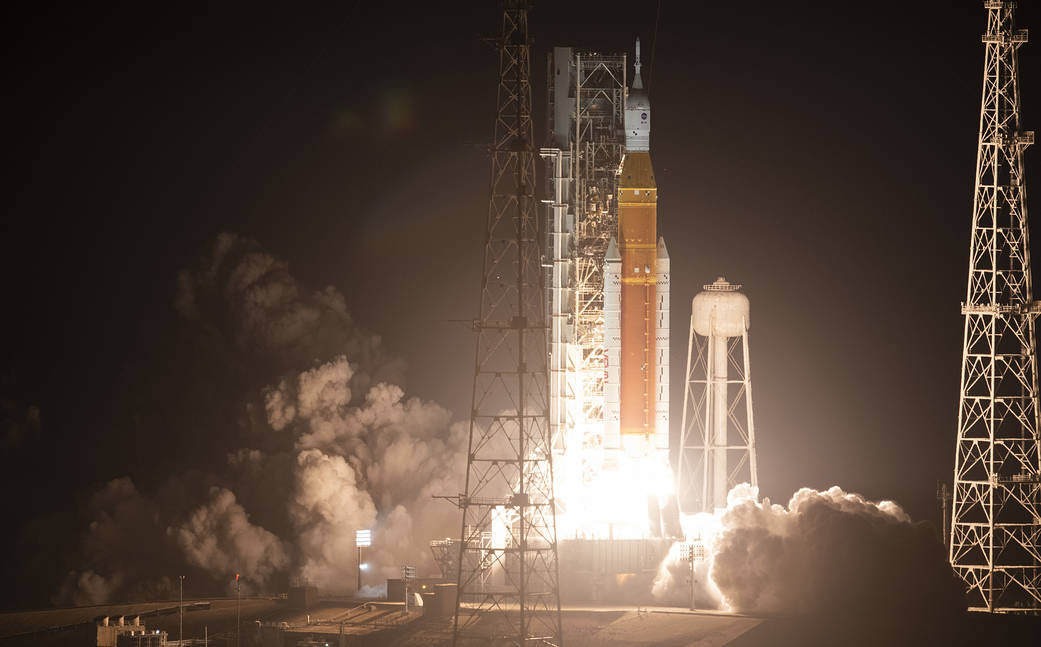
The Space Launch System, or, SLS, created by the national space agency of the United States of America (NASA), is classified as a super-heavy-lift space launch vehicle primarily having a goal of returning the human race to the lunar surface, to establish a sustained presence there, as a part of NASA's Artemis Program.
On November 16th, 2022, the SLS rocket embarked on its first journey to space, and not just space, but the moon. To start on a 25-day journey, the rocket lifted off from LC-39B from Kennedy Space Center in Florida. After the primary objective of circling the moon was completed, the Orion Space Capsule returned to Earth and splashed down in the ocean on December 11th.
SLS has proven that it is capable of reliably launching its crewed Orion capsule to lunar orbit and back. But the primary concern about this vehicle and rocket program is its long-term sustainability. The primary concerns with this launch vehicle developed by NASA are as follows:
- Outdated Technologies & Systems
- Excessive Cost
- Unreasonably Long and Consistent Delays
Firstly, on the topic of SLS' outdated technologies & systems, the Space Launch System rocket uses technologies that are so old and outdated that you'd think it's a joke. Most crewed rockets feature something called a launch escape, or, launch abort system, but we'll just refer to it as a LAS (launch abort system). The LAS is designed to quickly accelerate a crewed capsule away from the booster rocket launching it, in the event of a major system failure posing a threat to the safety and/or lives of the crew. Nowadays, crewed launch vehicles typically utilize hypergolic liquid propellant to power the LAS. Hypergolic propellants (specifically, Monomethylhydrazine and Dinitrogen Tetroxide, in this case) spontaneously combust upon contact and can be stored at room temperature, and allow for the avionics to be much simpler and more reliable. However, for Orion, NASA chose to use a solid-fuel LAS, a technology from the Apollo era (the 1960s). This technology is not only outdated but also more dangerous and less efficient than modern alternatives.
NASA's SLS program is an example of what happens when innovation is stifled by bureaucracy and a reliance on outdated systems. For humanity to truly progress in space, we must embrace new technologies and move away from the inefficient practices of the past. Companies like SpaceX are showing that there is a better way to reach the stars, and it's time for national space agencies to catch up or step aside.